There Must Be More To Life Than Having Everything
Vunkwan Tam
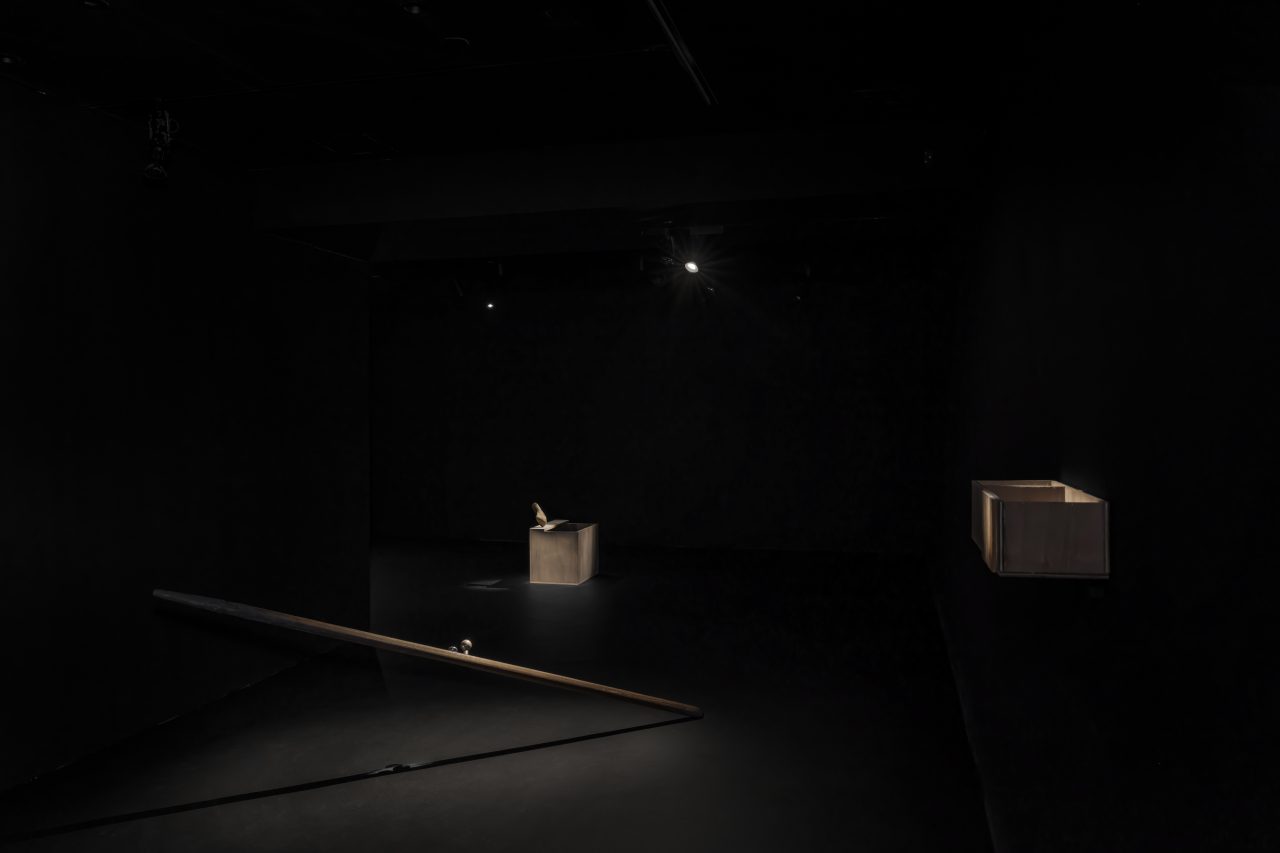
Photo by Byung Cheol Jeon
Empty Gallery is pleased to present There Must Be More To Life Than Having Everything, our second exhibition with Hong Kong-based artist Vunkwan Tam.
Originating from a popular children’s book, Tam’s choice of title takes on a different resonance in the context of his own continued exploration of the charged psychosocial residues of semiocapital—providing a kind of skeleton key with which we might approach his exhibition. Taking after psychoanalysis in suggesting that our most seemingly natural and fundamental desires might be irreparably flawed, he shifts between the perspectives of critical custodian, archaeologist, and undertaker in relation to the reproduction and circulation of these desires. Surveying the collection of found texts, objects, and affects which constitute the compositional elements of Tam’s sculptural palimpsests, we might say that his entire practice emerges from the obverse or remainder of cultural life—the “more” in relation to his titular “everything”. Through an attentive regard to these exhausted, frivolous, or unvalued leftovers of our libidinal economy, he excavates and embalms those clusters of signifying entities, which, for him, seem to embody the dream-like logic or hidden principle of our collective life. In There Must Be More To Life, Tam transposes this sense of oneiric logic into a spatial dramaturgy which guides us through the void from one work to another—resembling nothing so much as the liminal spaces or virtual overworlds of a PC adventure game.
A jagged wooden vertical whose torn outline suggests elemental calamity inhabits the center of a darkened initial chamber. This stake holds aloft, in a kind of purgatorial suspension, a spotted sheath of faded polyvinyl chloride—the cylindrical form of a disposable umbrella whose exhausted body floats before the viewer in a fraught compromise between abjection and exaltation. Low Damage invokes the long shadows of Surrealism, ecological terror, recent political history (and for those following Tam’s practice, perhaps even the Resident Evil franchise) while insisting on its own fragmentary multiplicity. The work resists full identification with any of these overdetermined readings, jettisoning any singular notion of what an umbrella might signify, refusing to shield us from the storm. Obstinate in presence, Low Damage appears to us simultaneously as atmospheric weathervane, enigmatic totem, and darkly comic guidepost into the fictive spaces of Tam’s exhibition.
Turning the corner, a radiant image of a glamorous blonde woman emerges from the darkness. As we draw closer, we recognise (or think we recognise) the iconic visage of the late Dolly Parton. OG Ending presents not a photograph of the country singer herself, but documentation of a wax effigy created in her likeness. Now inflected by mourning, Parton’s image—like the other forms which appear in Tam’s show—exists in a contemporaneity beyond what simple terms such as “mediated” or “overdetermined” can encompass. Chewed, digested, re-distributed and re-ingested like cattle cud, Parton’s likeness and the sticky complex of memes, fables, and rumors accompanying it have been subjected to the same type of circulatory violence as the rough hewn block of salvaged wood upon which they are projected. Tam’s work is made stranger to us through the impure hybridity of its form—the weightless holographic light of the digital image transforming to fill the wood’s porous and pitted surface, turning itself sculptural. OG Ending reveals to us that sentiment, and nostalgia too, are subject to mutation and decay as they circulate, qualitative changes which reveal the image as itself a type of matter no different from wood or steel.
Elsewhere, Tam strives to give form to a certain sense of futility or stasis. Whereas previous works consisted mainly of found objects arranged in relation to one another, Tam has now begun to incorporate his own gesture, albeit haltingly and minimally. Lifelong consists of a polyurethane shoe sole, which levitates dramatically above the edifice of an empty wooden container. The form and placement of this sole imply the arrested effort towards movement—the strain of the mover or the expectant tension of the sprinter. However, this movement, like the shoe sole itself, can only be ghostly and skeletal. Hollow and suspended, it is reduced to the barest outline of itself. Years As If No Years, Days As If No Days is a battered wash basin, empty save for a miniature concrete cylinder whose top has been painted blue. This unexpected hue functions as a perfunctory nod to the substance which might traditionally fill such a vessel, but instead of the mysterious internal movement of water, with its manifold reflections and shimmers, the viewer is confronted with the sterile immobility of reification. As a pair, these two works express a certain elegant impotence which bears witness to the emptiness of time.
This paradoxical sense of frozen or futile motion is expanded and mirrored in a series of pieces which Tam refers to informally as his “calendar works”. These handmade wooden containers function as primitive calendars or counting machines which house groupings of cryptic tokens. With each new day, an additional token is placed into one of the two compartments. The incremental passage of time is acknowledged, quantified, and represented but only for itself, performing a kind of solipsistic or trapped circulation. These are a pair of parallel temporalities which are suspended and purgatorial but also seem to be perpetually ending. This produces a sense of movement-within-stasis that feels at once ritualistic and game-like in its relation to the virtual. In the larger of these two works, entitled At The End Of The Game, The King And The Pawn Go Back Into The Same Box, Tam uses a series of white plaster eggs as counting tokens. These anachronistic forms bring to mind all the myriad associations of cultural history—the cyclical nature of time, the idea of primordial generativity, the human lifespan—and yet their poetic impact can only be described as one of mute neutrality. It is impossible then, to witness the reductive bleakness of Tam’s boxes and their eccentric cargo—chicken bones and plaster eggs, respectively—without considering the manner in which time is a container as well as the manner in which a container—through its functions of gathering, holding, and solidifying—can also be a tomb.
Tam has spoken, in connection with this show and his last exhibition, both of experiencing a renewed sense of the mystery of the world and of wanting to represent reality as something fundamentally plural, unknowable, and irreducible. But if There Must Be More To Life demonstrates a form of magical realism, it is of a particularly dark variety. And if it reveals to the viewer that mundane reality contains thresholds which conceal other worlds, then it presents these moments as mere glimpses of locked doors or inaccessible portals for which we must still retrieve the key.