rEceNt WoRkS
Jutta Koether
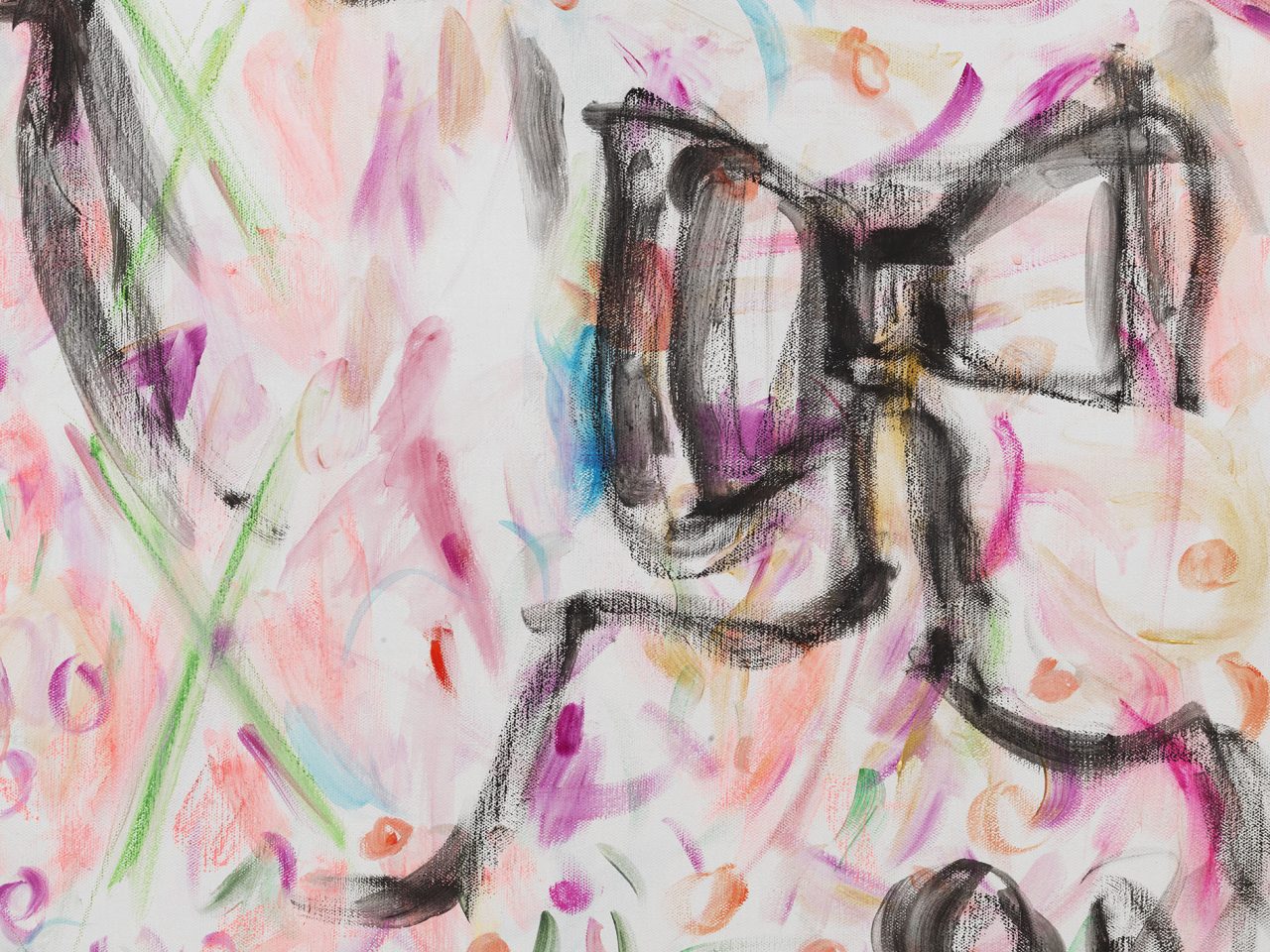
Jutta Koether, Rhythm Review I (je te veux), 2026, 3 parts, acrylic on canvas (detail)
Opening: Sunday, March 22, 4–8 PM
with a performance by Jutta Koether and Patrick Derivaz throughout
Empty Gallery is pleased to present rEceNt WoRkS, Jutta Koether’s first solo exhibition in Greater Asia.
For decades, Koether has pursued a practice which merges writing, painting, and performance in order to engage a reified art history on her own singular expressive terms. In her paintings, which also constitute a form of criticism, novel gestures emerge from a space of deep immersion into the aesthetic worlds and socio-cultural matrices attendant to particular artists. Creating through a movement of perpetual transmutation, she repurposes fragmentary elements drawn from canonical figures in order to generate a personal iconography which never seeks closure, but is instead defined by polyvocal openness and sense of parataxis. These charged borrowings and energetic re-makings—often conducted from a female point of view—reveal the mechanics of artistic performativity and self-commodification, as well as the submerged hierarchies of value implicit in our relationship to Art History. However, despite its critical valence, Koether’s method manages a rare and crucial feat. Through the sheer depth of its existential commitment, it exceeds the nihilistic self-absorption and facile end-game posturing characteristic of much “critical painting”, instead taking aim at the unresolved antinomy between sincerity and irony, romantic disclosure and critical distance.
In rEceNt WoRkS, Koether has created a suite of interconnected paintings which respond to the provocation of Empty Gallery’s unique spatial model. These new paintings primarily adopt the form of the triptych, conceptualizing each narrow panel as a physically separate but thematically interdependent monad. Within these shimmering fields of self-reference, we recognize a sprinkling of iconic forms—orbs and garlands, slashes and ribbons, fleshy flowers and gem-like portals. Past motifs and mannerisms jostle one another, creating new forms from the old—an unruly chorus of Koether-isms. Alternatingly dense and diaphanous, they contain unstable allusions to figures as varied as Alberto Giacometti, Emily Bronte, The Mustard Seed Garden Manual of Painting, and countless others.
Koether’s paintings are sutured to both each other and the space by a new gesture—an animated calligraphic blackness which flows across and through their densely marked surfaces. Floating above her vertical canvases like colophons or ersatz seal marks, Koether’s crawling brushstrokes appear to be simultaneously semic and asemic, figurative and abstract. Performing a collapse between the spheres of writing and painting, they appear as slowly oscillating counter-pulses floating above a backdrop of energetic staccato marks. Her mutating black line calls attention to the ellipses and gaps which serve simultaneously to punctuate and originate our own expression. These triptychs reach towards each other across the electrified void like wings of an altarpiece or folds of a fan—turning themselves out in order to fling their internal distance into the fertile darkness.
This unstable duality mediated through the hand occurs also in the various catch-phrases or inscriptions which populate the triptychs. In Rhythm Review (painting tout court), a translated Latin inscription which reads “We live by the spirit(s), the rest belongs to death” floats above the enormous, bloated unity of a single overflowing flesh-flower cum painters palette. Inside this form, nestled within the expanse of quivering brushstrokes lies the slogan “painting tout court”. This recycled motto exceeds its own literal meaning to assert that every thing which exists can belong to the domain of painting, be consumed by it it or possessed by its ghosts. A multitude of other forms proliferate within the space of these panels. Smirkily expressive spheres slyly allude to the aforementioned spirits, whilst the vibratory and self-complexifying scribbles which form the letter “A”—perhaps representing a mark of rank or quality—resemble transmitting radio towers or hastily scribbled stars. These fuzzy stars leap from one surface to another, before finally, drained of color, they tumble exhausted off the canvas, fall down to earth.
Koether’s stars assume the form of dime-store novelty canvases, materials once destined only for the children’s art class or the nursing home. Stacked one upon the other, they become a sort of abstract tableaux, resembling an abyssal landscape or a graveyard of extinguished singularities. Their diminutive forms threaten to be swallowed by the ground of the gallery, to dissolve or disappear, losing their existence and individuality in an overwhelming black absence. At first glance, Inseparables II seems to suggest the death of the subject in a wholly pessimistic fashion, calling to mind the bombastic decay of expression and individuation which so obsessed the members of the Institut für Sozialforschung. Despite all this, they still harbor an internal luminosity, a fragile presencing which rejects the overdetermined and deformed residues of a toxic idealism. The spirit persists in its rebellious iridescence, in spite of, or perhaps because of, its degraded circumstances.
To borrow the title of one of Koether’s star paintings, rEceNt WoRkS operates along a vector of de-finalization. While it initiates a kind of retrospection or review of previous forms and moments from her artistic as well as personal history, it refuses to work towards definition and closure—preferring instead a gesture of loosening, an expansion or opening to the world. Clusters of familiar motifs are decontextualized and set in motion to the terms of an evolving rhythm, an improvisatory waltz between life and death, fullness and void. In the end, a notion emerges from the resonances within and between these canvases, symbols, architectures. An artistic practice, which is just another way of referring to a life, must reject the artificial closure of fixed iconographies and narratives, constantly upending itself and imagining itself anew from the ruins of its own history.
* * *
Jutta Koether, born in Cologne, lives and works in Berlin and New York. Since the 1980s, she has been developing an alternative genealogy and practice of painting that have decisively shaped the current understanding of the medium. She programmatically connects her painting to performance, music, and textual production, and works and worked in collaborative projects with Reena Spaulings, Tom Verlaine, Steven Parrino, John Miller, Tony Conrad, and Kim Gordon, among others.
Koether’s work was the subject of a comprehensive survey exhibition at the Museum Brandhorst in Munich and the Mudam in Luxembourg in 2018 and 2019. Other exhibitions of her work have been held at Artium Museoa in Vitoria-Gasteiz (2022), Museum Abteiberg in Mönchengladbach (2019), Dundee Contemporary Arts (2013), Moderna Museet in Stockholm (2011), Van Abbemuseum in Eindhoven (2009), and Kunsthalle Bern (2009). Her works are in collections of international museums, such as the Museum of Modern Art and Whitney Museum of American Art in New York, Museum of Contemporary Art in Los Angeles, Berlin National Gallery, Museum Brandhorst in Munich, Museum moderner Kunst Stiftung Ludwig Vienna, Museum Ludwig Cologne, and Stedelijk Museum Amsterdam.
Koether was a professor of painting and drawing at the Hamburg University of Fine Arts from 2010 to 2024. Previously, she taught at Columbia University, Cooper Union School of Art and School of Visual Art in New York, Bard College in Annandale-on-Hudson, Yale University in New Haven, Universität der Künste in Berlin and Kongelige Danske Kunstakademi in Copenhagen, among others.