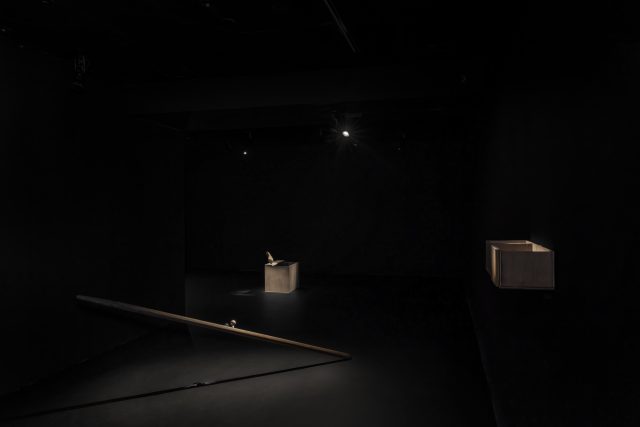
GHOSTLY, GODLY/人間》opens in Hong Kong on March 21, supported by the Octone Foundation.
Contemporary art’s engagements with Modernity and Hauntology continue to provoke essential reflections on history and reality. This curatorial experiment explores their untapped possibilities within specific East Asian contexts. Set in Hong Kong—where Buddhism and Daoism thrive alongside deeply lived folk beliefs that shape not only spiritual life but also social, cultural, and political realities—the exhibition highlights the intangible yet constant presence of the ghostly and the divine in everyday human–world relations. The English title GHOSTLY, GODLY captures this spectral dimension, while the Chinese title 人間 (Human Realm, Ningenkai) evokes the unresolved, bittersweet present of Buddhist cosmology, where joy and suffering coexist and call for ongoing practice.
Curated by Chris Wan, the show presents newly commissioned works, existing pieces, archives, and documents by artists Simon Liu, Cici Wu, Tang Kwok-hin, Ha Bik Chuen, and On Kino. Fully supported by the Octone Foundation, this project fosters experimental curating and artistic creation outside conventional institutional frameworks.
New Humans: Memories of the Future will inaugurate the New Museum’s expanded building with an exploration of artists’ enduring preoccupation with what it means to be human in the face of sweeping technological changes. New Humans will trace a diagonal history of the twentieth and twenty-first centuries through the work of more than 150 international artists, writers, scientists, architects, and filmmakers, highlighting key moments when dramatic technological and social changes spurred new conceptions of humanity and new visions for its possible futures.
March 5 – April 18, 2026: Jessica Silverman is pleased to present “Beauty is the Best Defense,” a group exhibition that reframes decorative excess as a form of wit, resistance, and genderful expression. The exhibition runs from March 5–April 18, 2026. Spanning generations and geographies, the eight artists in this show explore ornament as armor and beauty as a survival tactic, mounting a spirited challenge to the long-held assumption that Minimalism represents the epitome of tasteful restraint and aesthetic discipline. That assumption, the exhibition suggests, has always conformed to an Anglo-Saxon, masculine norm—one that these artists collectively unsettle, complicate, and transcend.
The participating artists are: Lari Pittman, Grayson Perry, Ilana Savdie, Rose B. Simpson, Ramekon O’Arwisters, Tishan Hsu, Lehuauakea, and Karim Boumjimar.
Aaina Bhargava reviews La Moustache in Frieze Magazine: “A mound of sand sits on the top floor of Empty Gallery in Hong Kong, glistening in the gallery’s signature pitch-black darkness. Nearby, a staircase leads to the level below. As if hovering like a mirage or suspended in mid-air, a stream of sand trickles to the ground. In Paul Kos’s Sand Piece (1971), grains filter through a small aperture in the ceiling above, creating a captivating illusory effect of extreme slow motion.”
At Jacqueline Kiyomi Gork’s “Gama,” Empty Gallery’s pitch-black, two-floor void functioned less as backdrop than as active medium. For her third solo exhibition with the black-box space, Gork continued to nurture darkness as a collaborator, allowing the works to unfold as a single, cavernous installation.
Cold air and darkness seized the senses upon entry. A short corridor and unguarded reception area led to Gork’s conceptual, deconstructed “cave,” where the titular sculptures, Gama 1, 2, and 3 (all 2025), emerged as sequences of chunky terracotta tiles suspended on steel frames. Named after the Okinawan word gama, meaning “cave,” the series uses the island’s red clay to trace the interior impressions of Shimuku Gama, where Gork first conceived these works. Conceived as “permeable membranes,” the blocks of terracotta hover ominously in liminal darkness, solid and weighty yet cracked and vulnerable.
Chan Hau Chun’s Map of Traces will be on view at Cushion Works in San Francisco from February 21 through April 4. Map of Traces (2025) is a 29-minute film by Hong Kong artist Chan Hau Chun. It was recorded on MiniDV, Google Street View, police surveillance cameras, and various phones. Its primary subject is human relationships in the wake of the 2019 demonstrations. Its many opposites include redaction and revelation, exile and homecoming, the fugitive and the fixed. Its cardinal tension lies in the gap between authorized narrative and lived experience.
Mask, umbrella, camera, uniform, glasses, backpack, barricades. The grain of memory, a low-hanging fog. How best to distinguish between what’s happened, what’s here, and what’s around the bend? Throughout, the tink tink tink of the crosswalk signal. When to stop, when to go, when to run.
Hannah Sage Kay writes in The Guardian:
Jacqueline Kiyomi Gork has created a sound installation emulating second world war spaces: a Japanese internment camp in California and caves used as bunkers in Okinawa
In 1945, during the Battle of Okinawa, the great-uncle of the Japanese-American, Los Angeles-based artist Jacqueline Kiyomi Gork was stationed on the island as a US solider, having volunteered for service probably in the hopes that his family might be spared from the Japanese internment camps back home. They weren’t, and so while his siblings and parents were incarcerated at Tule Lake in northern California, he was on the frontlines in what has been deemed one of the bloodiest conflicts in the Pacific during the second world war.
From ARTnews: Opening on April 16, this edition of Greater New York will mark PS1’s 50th anniversary, and rather than bringing on any outside curators, the museum has this time leaned on its staff to organize the show. The exhibition’s curatorial team includes director Connie Butler, chief curator and director of curatorial affairs Ruba Katrib, associate curators Jody Graf and Elena Ketelsen, assistant curator Kari Rittenbach, curatorial assistant Sheldon Gooch, and curatorial coordinator Andrea Sánchez.
Taro Masushio and Cici Wu are amongst the participating artists of this year’s exhibition. Please see the link below for further information.
On February 6 and 7, Vunkwan Tam will be exhibiting new works as part of an exhibition, 野有死蘭, in Room 303 at the Jockey Club Creative Arts Centre, Hong Kong. Venue support from Crash.
Jaime Chu reviews La Moustache in issue #86 of Spike Magazine, Salad Days: “What is the fine line between undiagnosed paranoia and collective psychosis? Emmanuel Carrère’s 2005 film La Moustache, adapted from his own 1986 novel of the same name, portrays Marc, a Parisian architect who decides to shave off his mustache before a party one night. To spiraling consequences, it turns out: for neither his friends, nor his coworkers, nor his wife acknowledge the difference, even denying that he ever had a mustache to begin with. When his wife threatens to send him to a psychiatric institution, Marc, in a moment of panic, makes an escape, boarding the next plane out of Paris to Hong Kong.
A reality without consensus, and the destabilizing effect an experience of it might prompt, is the subject of a formally attentive and hermeneutically provocative exhibition curated by Jordan Stein, a longtime fixture of Bay Area arts, at Hong Kong’s Empty Gallery. His riff on Carrère begins in a kind of foyer, where a trio of found-object works set the table for a negotiation between the dissemination and containment of uncomfortable knowledge.”
A Psychological Thriller Comes to Life in Hong Kong Aaina Bhargava on La Moustache in Frieze February 20, 2026
Closed for Installation Jutta Koether | rEceNt WoRkS Opening March 22, 4–8pm March 22 – June 20, 2026